

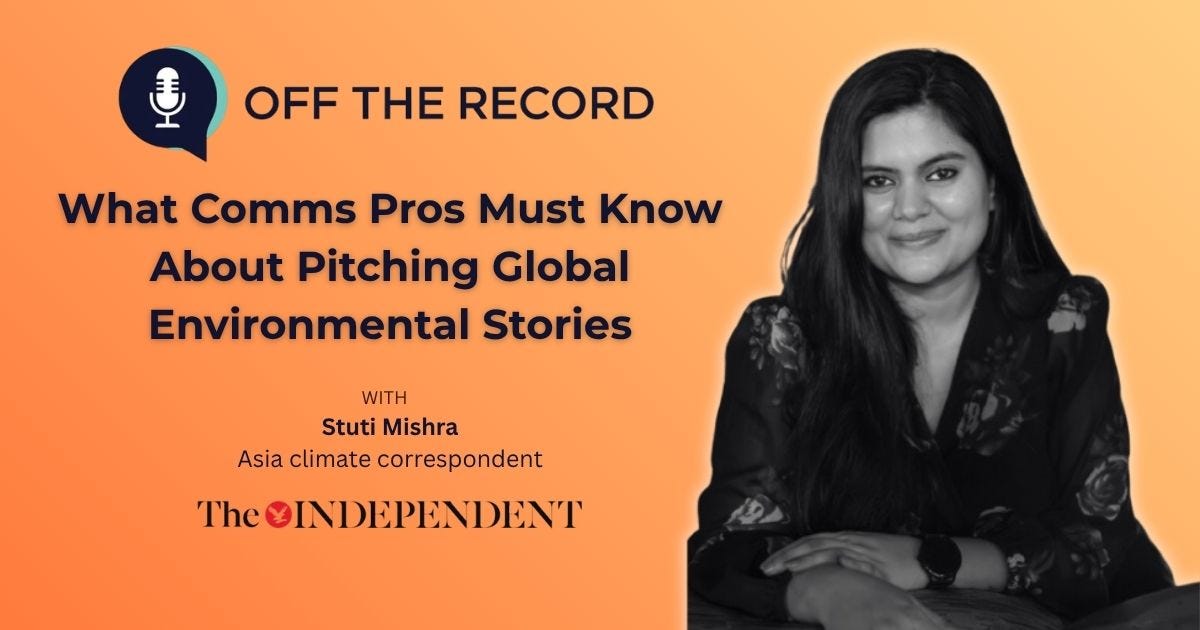
Stuti Mishra, The Independent’s Asia Climate Correspondent, is in the Off the Record hot seat as we kick of June.
She describes what reporting on environmental issues across Asia is like, as well as what makes a climate story resonate with UK readers. She dives into planning around COP and the importance of strong visuals.
Stuti, do you get to travel across the region often and if not, how can comms pros help facilitate stories for you? Honestly, not as often as I would like. I’m based in New Delhi, in India, which means I cover an enormous region like Asia-Pacific largely through phone, email and a lot of creative source-building. What genuinely helps is when comms teams think beyond the press release: connecting me directly with people on the ground, offering local contacts where relevant or flagging stories in places I simply don’t have existing contacts.
If you have someone in, say, rural Bangladesh or a fishing community in the Philippines who can speak to what’s happening when a larger story breaks, that’s gold. Don’t assume I can just hop on a plane.
What helps to make a climate story from Asia feel relevant to a UK audience? Human impact, money, supply chains and weather. UK readers are more connected to Asia’s climate crisis than they realise - the clothes they wear, the food they eat, the floods that delay their deliveries - all of it connects people worldwide. If a story has a thread I can pull that lands somewhere tangible for someone in Manchester or Edinburgh, it works. Human stakes also matter enormously. A statistic about sea level rise is forgettable but a family who has moved three times in a decade because of it is not.
Do you think the environment is having a tough time in the UK media at the moment? Has appetite changed in recent years? It goes in waves, and right now the wave is a bit choppy. Cost of living, geopolitics and political volatility have crowded the news agenda. Climate doesn’t disappear from it, but it has to work harder to get in, which means the “this is happening somewhere far away” frame almost never cuts it anymore. What still lands is climate as an economics story, a health story or a security story.
How far in advance should comms teams pitch around major climate moments like COP or extreme weather seasons? For COP, I would say six to eight weeks ahead for features and analysis because I’m already thinking about my coverage plan by then and late pitches get lost in the noise. For breaking stories like a cyclone or a heatwave then the same day or within hours. If you have someone relevant to a story that’s already moving, get in touch immediately because I am most probably on a live blog or filing the same day.
What kind of access is hardest to get when reporting on climate issues in Asia? Government officials who’ll speak frankly, every single time. There’s an enormous gap between what the data shows and what ministries are willing to say on the record. I would also add: communities most affected by climate impacts like displaced people, subsistence farmers and coastal fisherfolk who are hard to reach without serious local infrastructure. If you can bridge that gap, I’m genuinely interested.
What sorts of climate stories are you actively looking for but rarely receive? The range is bigger than people assume. Working for a general news focused outlet, I am always across the big headlines like disasters, policy moments or emissions data. But between I’m also actively looking for stories that don’t wait for a crisis to matter. New solutions and technologies. How the flow, or absence, of climate finance from the global north is shaping what’s possible in the global south.
Health impacts from pollution and environmental degradation that could be a warning for others. And quieter stories like choices ordinary people make every day that are being shaped by a changing climate, often without them framing it that way. If it connects environment to money, health or how people live, I would be interested in knowing about it.
How much does visual content matter when deciding whether to pursue a story? A lot, especially for features. We’re a digital-first publication and strong images or video can be the difference between a story getting space or not. If you have it, lead with it.
Do you prefer being pitched broad trends or very specific case studies? Specific cases with a broader hook. Give me the person, the place, the detail - and then tell me why it matters beyond that village or that company.
Best place for people to get in touch with you? Email is always best — stuti.mishra@independent.co.uk. But things do get lost in my inbox so feel free so also reach out again or ask me on LinkedIn, though I don’t check it every day, so if something is time-sensitive, email is the way to go.
Remember folks, keep this just between us! We’re off the record.
Thank you for reading Off the Record! We want to make our newsletter as helpful as we can, so please get in contact if there’s anything specific you want to see.
We offer media masterclasses for brands/PRs/organisations looking to sharpen their storytelling, improve their relationships with journalists and boost their media coverage. If you’re interested, please email us at info@offtherecordmedia.co.uk