

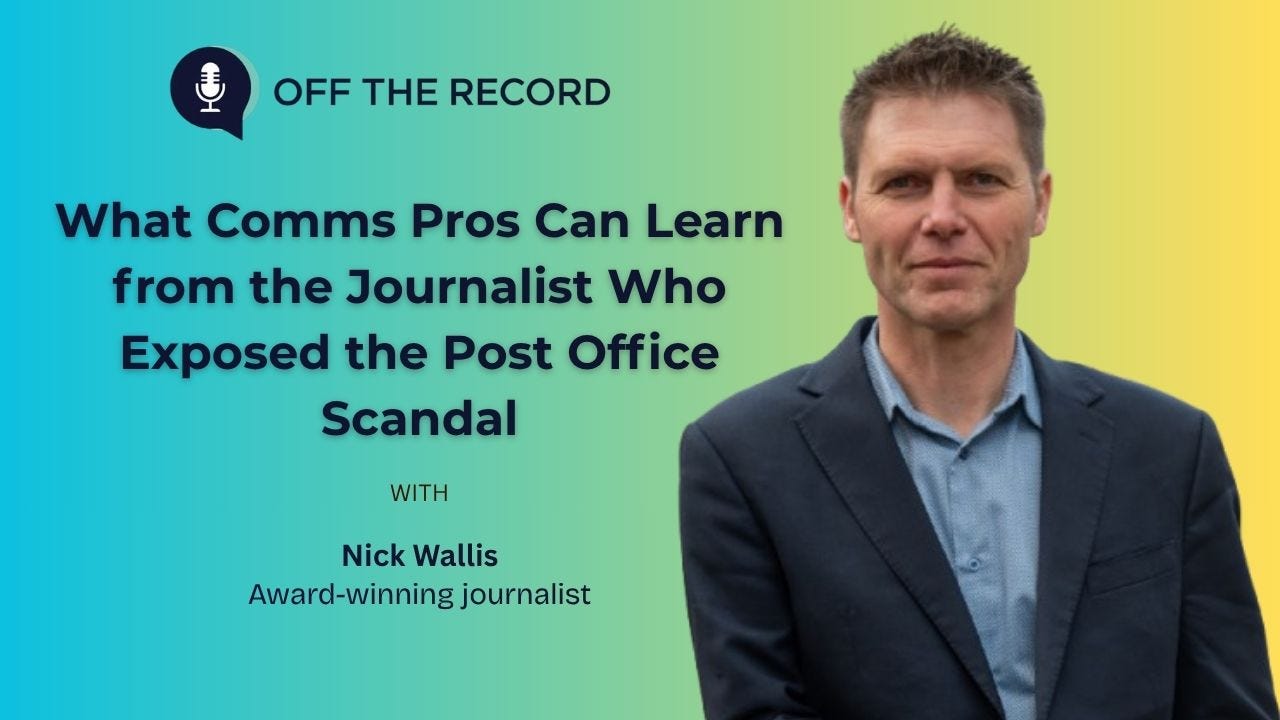
Ladies and gentlemen, it gives me enormous pleasure to introduce Nick Wallis. In many ways, this is more of a reintroduction because chances are you already know his work... even if you don’t realise it.
Nick is the investigative journalist whose relentless reporting brought the Post Office scandal into the national spotlight and helped expose one of the biggest miscarriages of justice in modern British history. I have followed his work since I joined the industry in 2019. As a cub reporter who had just dipped her toe into journalism for the first time, he was probably the first UK reporter I looked up to.
In this edition, he shares what comms pros often misunderstand about investigative journalists and the lessons organisations still haven’t learned from major crises.
What is the biggest misconception communications professionals have about investigative journalists? That we’re not onto something potentially very serious.
The Post Office story became one of the biggest scandals in modern Britain. Talk me through the moment you realised it was much bigger than a miscarriage of justice affecting just a handful of sub-postmasters? There were two big moments. The first was in 2018 when Alan Bates announced he had got more than 500 people together to take on the Post Office at the High Court which was a significant number, but a relatively small fraction (61) of them had criminal convictions. The biggest moment for me came in 2020 when a line in the “notes for editors” part of a Post Office press release said it was looking at “other” convictions. I went back and asked how many “other” convictions. They told me it was at least 500, which blew my mind. We’d spent more than a decade wondering if we might one day find out if there were more than 100 people claiming they’d been falsely convicted. It was at that point I started calling the Post Office story “a scandal you can see from space”. I took the story straight to the Daily Mail but because we were in the middle of the Covid pandemic it made page 27.
One of the things that stands out about your work is the trust you’ve built with sources over many years. What’s your approach to developing and maintaining those relationships? You have a duty of care to everyone you deal with which involves explaining everything you can about the implications of putting their story or information into the public domain. People can sometimes invest a huge amount of emotional energy in a story and you are tied up with that in their minds. You have to work out how to remain professional whilst also being empathetic towards people who have likely been through more than you ever will and are now potentially suffering the effects of having to revisit the story for your benefit. We don’t teach journalists about this enough. You also have a duty to handle personal information carefully and never, ever betray a source, whatever the consequences.

In your experience, what mistakes do organisations make when responding to highly emotional public debates or crises? It is firstly about spending as little money as possible, then it’s about self-preservation. They never consider first the harm they might have done.
For communications professionals, what’s the biggest lesson from the Depp v Heard saga about reputation in the social media age? Everyone believes their own story. If those stories appear to be departing from the established facts, less may be more.
What makes a communications professional genuinely useful to a journalist Anyone willing to give context off the record. We need to understand the story in the round to stop us making mistakes.
Quick-fire…
Most underrated journalism skill? Turning up half an hour early.
Most important quality in a communications professional? Responsiveness.
Biggest journalistic lesson from the Post Office story? If there are questions which remain unanswered, it’s probably worth pursuing.
What are you reading, listening and watching at the moment? Reading - I’ve just finished Hounded by Jenny Lindsay, which is superb. I am currently reading James by Percival Everett. I couldn’t sleep last night so I got through quite a bit of it.
Watching - I watched Dear England on Saturday, but apart from that it tends to be live sport and the News.
Listening - I’m on a bit of a Damned roll at the moment, but if you want something modern - Sharon van Etten. I’m never too far from The Cure, though.
Best place for people to contact you? I’m very easy to find. If anyone wants me to come in and talk to their comms or leadership teams about the Post Office scandal, how to navigate the gender wars without upsetting everyone, or journalism in general, I’d be grateful if people did come and find me. I need the work!
Remember folks, keep this just between us! We’re off the record.
Thank you for reading Off the Record! We want to make our newsletter as helpful as we can, so please get in contact if there’s anything specific you want to see.
We offer media masterclasses for brands/PRs/organisations looking to sharpen their storytelling, improve their relationships with journalists and boost their media coverage. If you’re interested, please email us at info@offtherecordmedia.co.uk
Thanks for doing this. Just having a listen now. My only complaint is that I wish it was a whole series of hour long interviews! Great job though