

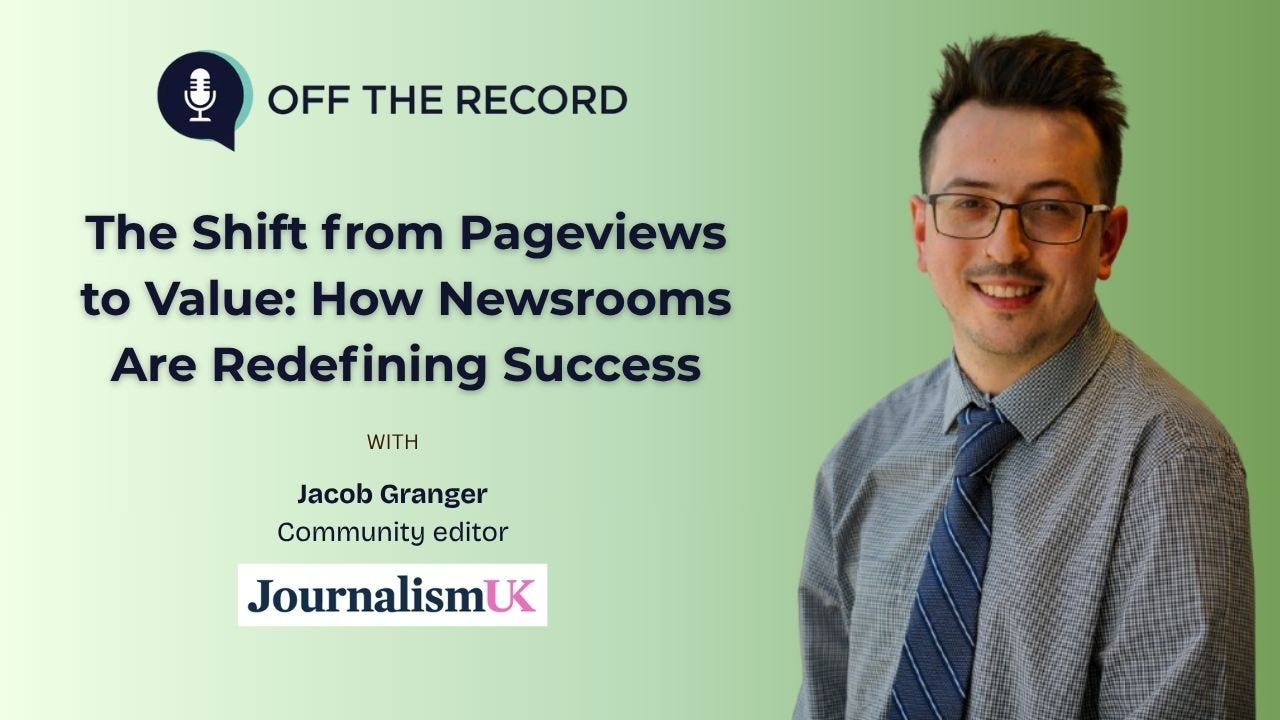
Jacob Granger, community editor at Journalism UK, is taking the reins of Off the Record this week. The media insider unpacks how newsrooms are evolving and helps unpack the shift from volume-driven journalism to a model built on audience value, engagement and trust.
Jacob, you’ve told me that journalism is moving from a “volume-based” era to a “value-based” era. What does that shift actually look like in practice inside modern newsrooms? How should comms pros adapt? It means that we are in the midst of changing metrics of success. Newsrooms are fighting hard for each and every user action beyond just simply clicking in and out of an article. It’s not only the page view column that matters and where newsrooms might have longer-term goals.
They are watching their dashboards closely for all sorts of other indicative behaviour metrics to influence commissioning decisions – from user journeys to registration conversions, to more sophisticated combined user metric scores. The FT for example uses a RFV (recency, frequency, volume) score to judge the success of articles. A story isn’t just a story because it’s going to get eyeballs across social and digital. A story might be a story because it will resonate deeply with their most loyal user base or convince elusive users to take an important step in the funnel.
Good editors will be aware of these subtle shifts and attitudes in their readership. Comms folk should not just think about how far stories might travel, but about how they nurture the relationships newsrooms are fostering with their readers.
How much of this shift is driven by audience expectations and how much is driven by business models like subscriptions? A little bit of both, and they’re actually connected if you think about it. We are living in times of information overload and articles that fail to meet audiences needs are simply not going to be given the time of day. And worse, it will discourage readers from coming back in the future.
At the same time, digital advertising is in severe decline in the news business, and so a lot of advertising-driven outlets have to stuff their pages with more ads to keep the business operational – much to readers’ dismay. It’s very hard to focus on these types of sites and the user experience is sub-optimal. The tide is somewhat turning and those outlets – typically local news organisations – are veering into subscription and ad-lite/ad-free models.
However, if you’re going to charge users per month in a cost of living crisis (and when people are used to getting content for free) you need to make sure you’re delivering enough return on value and expectations. Volume still matters because you need to be in a constant state of marketing and growth in terms of subscription numbers, but hanging onto them (especially beyond cheap introductory offers) is the big challenge. And user value is our best shot.
You talked to me about journalism becoming more audience-centric. What does “serving audiences well” mean today? The answer to that question depends on your organisation. Any good audience-centric newsroom will have done the legwork to understand what audiences expect from them and what they come to them for. That won’t be the same for every news organisation – readers of The Mirror have different needs to readers of The Guardian. They could be similar as they’re both national publishers. But they’ll be very different from a local news organisation or a specialist title. If you’re pitching to a media company, do the research. Look at their mission statement, look at sites like ours and others (JournalismUK) if they’ve openly spoken about what sort of content they’re focused on, look at their website or press corner for any curious new launches around new verticals, campaigns, series podcasts and so on. These are quite telling about the direction they’re moving in.
What will successful newsrooms look like in five years? It’s difficult to predict one year in advance let alone five! God knows. I’d like to think that mission-driven journalism will always find a way to survive. It may not resemble what it is today, it may well look a lot more content creator-esque, for example. It will have to be a lot more automated and AI-savvy in my view – there’s no sense being left in the dust by competitors. But that doesn’t have to be a bad thing, as long as we are getting relevant, robust and responsible reporting in front of people.
You’ve said editors can’t just publish whatever PR sends through. What should comms teams understand about how editorial decision-making may have changed? There’s two things I would say: The user needs model is the number one framework for making commissioning decisions today. A genius called Dmitry Shishkin pioneered it at the BBC, and it has had an enormous ripple effect in the industry. It has since evolved into the 2.0 model and a sports-specific variant, and it basically tells broadly what needs news consumers want met when consuming content.
If you track this over time, it reveals exactly the demand in your readership, and if you can have a savvier and more efficient commissioning model if you produce more of what people want, and less of what they don’t want. The model came with the uncomfortable realisation that most news outlets do too much ‘update me’ content, and leave large parts of their audiences as untapped potential because they’re hungry for content that isn’t served up enough. The bottom line: if an editor is telling you your pitch needs a new approach, new angle or just isn’t a story, trust their instincts and go with their judgement.
Point number two is AI - there’s a lot to say about this but to keep it brief… Newsrooms are increasingly being duped by sources posing as legitimate but are in fact products of generative AI. De Telegraaf in The Netherlands is the latest to fall victim of this, but there’s been lots of examples. Press Gazette have done first-class work exposing this problem. Editors have every right to be very cautious and guarded over what they’re commissioning. Trust towards the media is not a given nowadays. In fact, it’s a luxury that many cannot afford to jeopardise. Be prepared to show your legitimacy and your access to sources.
Quick fire round:
One sentence to describe the future of journalism? In the air… disruptors are everywhere, from AI companies to content creators.
The fastest way for a pitch to get deleted? Being difficult to work with, like meddling with the story or insisting on it being told a certain way.
One thing PR people think editors want that they actually don’t? Earned media… covertly placing a product into a story is serving your interests, not the audience.
Best way to contact you? Connect me with me on LinkedIn. Please feel free to join our JUK community while you are there and our mailing list for updates on our work.
Remember folks, keep this just between us! We’re off the record.
Thank you for reading Off the Record! We want to make our newsletter as helpful as we can, so please get in contact if there’s anything specific you want to see.
We offer media masterclasses for brands/PRs/organisations looking to sharpen their storytelling, improve their relationships with journalists and boost their media coverage. If you’re interested, please email us at info@offtherecordmedia.co.uk