

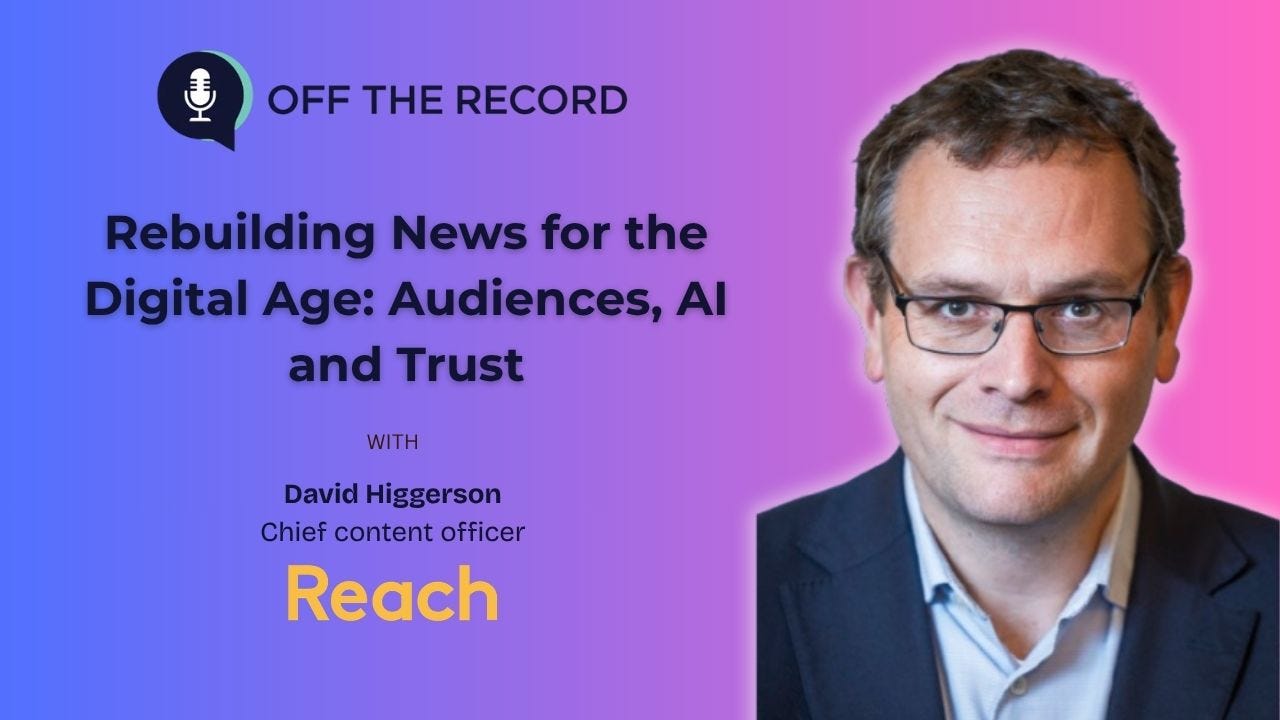
I’m delighted to introduce my boss’s boss’s boss’s boss… you get the idea! David Higgerson is chief content officer at Reach plc (publisher of the Daily Express, Daily Mirror, Daily Star and a vast portfolio of local titles). He’s also been a long-time fan of Off the Record (which I’m incredibly grateful for)!
Today, David is taking over the reins of the newsletter, sharing his do’s and don’ts for comms pros. He dives into the impact of AI on newsrooms, what the news creator economy means for the industry and how both are reshaping the relationship between journalists and comms pros.
David, if you were starting Reach from scratch, what would be the digital model? Subscriptions, hits online, keeping papers going as long as possible etc? This is the question I asked our editors when we set out to restructure editorial last year.
We’re a company which exists to connect with people where they live and what interests them, building a sustainable future for journalism in the process, and I believe we have to look to audiences and understand what they want to determine what that model is.
For journalism to be effective, it needs to be seen by lots of people - the people who it can stand up for, the people it can help, and also the people it needs to stand up to.
90% of people in the UK say they wouldn’t pay for news - there are many reasons for that – from the BBC being all dominant through to the cost of living crisis. So if I was building Reach from scratch today, I’d want a model which set out to reach as many people as possible by understanding how our journalism can make a difference to their lives.
Subscriptions would be an important part of the model, but not in a “walled garden” way - but in the way we are pursuing it, offering a premium tier to readers who really value deeply what we do.
Placing a greater emphasis on the relationship between individual journalists and readers - as we’re seeing with the growing news creator economy - is essential too.
While newspaper circulation is in decline, we are very lucky to have so many brands which have such history in the UK and Ireland. It would be very hard to recreate that starting from scratch today. It’s not just about keeping them going for as long as possible - for me, it’s about understanding the particular needs of print readers and making us part of their daily routine for as long as possible.
Like all publishers, we need to learn and adapt to forms of storytelling which we weren’t traditionally known for - in our case, audio and video, and that is something we are putting at the heart of the business.
What role do you see AI playing in newsrooms over the next five years? AI is an opportunity and a threat to journalism. We’ve seen the impact of AI Overviews on audiences from Google, and also how AI is used to perpetuate dis and misinformation rapidly around the globe. The ability to dupe the public with AI is a constant threat both in civil society and for journalists going about their work, making life harder.
AI however has a massive role to play in helping us do the job we want to do, cutting out the more tedious parts of the job - especially in digital storytelling - so we can focus on the parts of the job we enjoy the most and which the reader values the most.
AI will help us reach more people, in more formats, more quickly, and we already have lots of examples of that at Reach. It has to be built on the basis of helping journalism, which is our starting point.
Are there any newsroom tasks you think AI should definitely not touch? AI should not be used to do anything which interferes with the most important commodity in journalism: Trust. We need people to trust us with their stories, and to trust us to represent them and their communities fairly. There are loads of ways AI can help with storytelling, but it must do so within these parameters.
The most important relationship in journalism is between the journalist/publication and the reader. The reader is choosing us over multiple other sources, including on social media, where AI-generated content can often be alluring.
So to answer your question, AI cannot replace key editorial decision making - be that from the reporter when they are deciding which angle to pursue, and which questions to ask, through to the news editor deciding what to place and where, to the editor ultimately setting the agenda for his or her title.
Within that, we should of course always experiment with how AI can help us, but not replace the critical decision making at every step of the process.
Reach has a “whitelist” of trusted PR firms to curb fake AI experts. Do you see the whitelist as a temporary fix or part of your long‑term editorial process? I’d love it to be temporary, but we have to be realistic that there are bad actors who want to try and dupe their way into legitimate media coverage.
The white list has received a lot of press. What we’ve created is an AI “detective” tool which can help journalists when dealing with press releases to understand how credible the source is. This tool gives an instant report on a release, grading it on everything from the credibility of the expert sources, to the PR company itself, to the claims within the release. It’s always still up to the journalist to decide whether they want to pursue the story or not.
Whether the PR is known to us is just one of the factors that the tool reports on and PR firms go on to the white list if they are endorsed or recommended by one of Reach’s journalists. It means that when the Detective tool reports back on the press release being reviewed, it can reference whether or not another Reach journalist has endorsed the PR firm sending it. It’s a version of asking around in the newsroom if your colleagues have ever worked with someone before and would vouch for them - only using the Detective, journalists can draw on the advice of hundreds of colleagues.
In an ideal world, journalists should be able to spend time focusing on what is being said in a press release, and validating it, rather than having to prove whether the quoted person is real. But we are where we are, and we’re trying to make it as quick as possible for our journalists to be able to do that verification.
The whole industry is losing paper sales and has done so for decades. Do you think there will always be a role for them even when they are loss making? Yes, and I don’t necessarily think we should assume they will be loss making. I don’t see a world where there will be a state subsidy to support loss-making newspapers, so the question then becomes what newspapers become to ensure we can sustain them.
A little bit like the vinyl revival, I believe the slow news movement will sustain printed papers in some form or another.
But journalism’s future is an online one in the main, and it’s essential we keep responding to changes in audience habits, and find ways to sustain our journalism as we go. There’s a lot which could be done to help us in this regard, both locally and nationally, which we are pushing Government on.
Quick fire round...
Coffee first thing or emails first thing? Tea first thing and daylight before screen light!
One word to describe your inbox Rewarding.
One thing comms pros should do more of? Connect with journalists directly, and personally. I keep being told journalists are harder to connect with due to their being fewer physical newspaper offices. We’re easier to contact than ever.
One thing comms pros should do less of? Seeking coverage when links are incredibly tenuous to a title or area. Pet peeves are the [name of place] ones where the location relevance is no deeper than naming a place, or the statistical ones which are incredibly dubious and don’t stand up to scrutiny.
Remember folks, keep this just between us! We’re off the record.
Thank you for reading Off the Record! We want to make our newsletter as helpful as we can, so please get in contact if there’s anything specific you want to see.
We offer media masterclasses for brands/PRs/organisations looking to sharpen their storytelling, improve their relationships with journalists and boost their media coverage. If you’re interested, please email us at info@offtherecordmedia.co.uk