

When it comes to pitching national stories to regional newsrooms, the key question is always: what’s the local angle? At ITV Meridian, stories need to resonate with the people, businesses and communities across the South of England. This means national news only works when there’s a clear local connection.
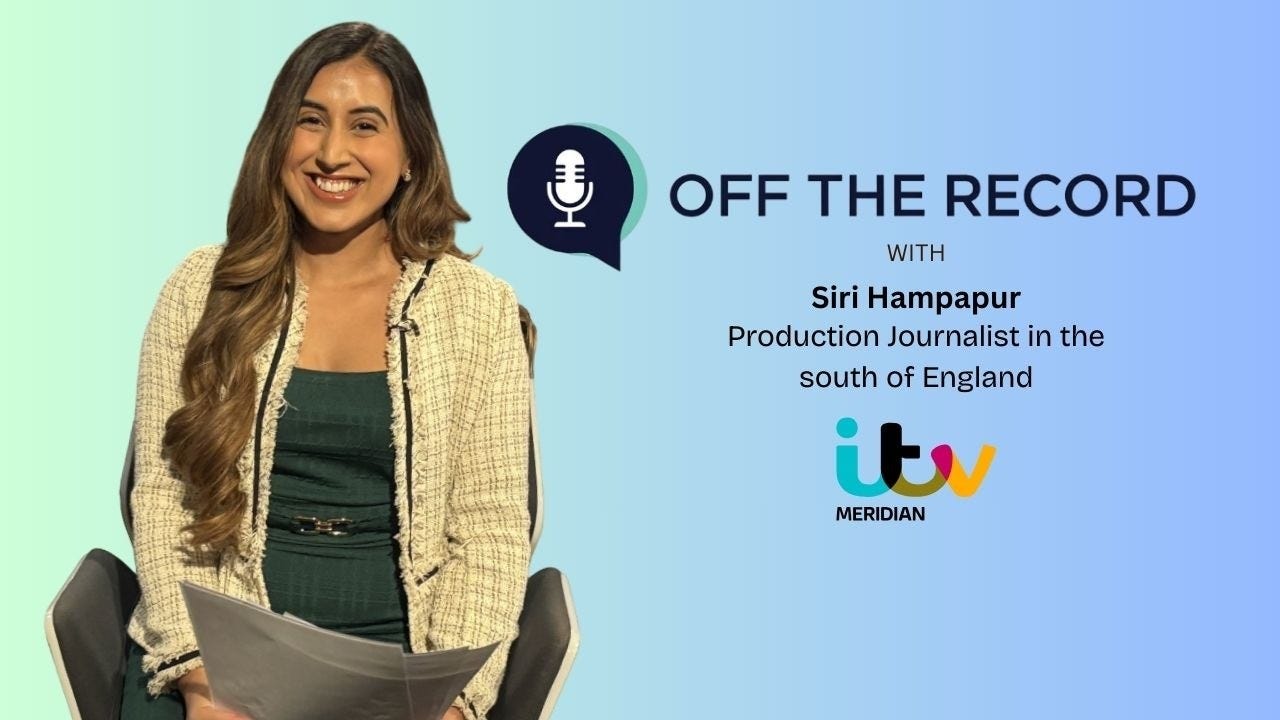
In this edition of Off the Record, production journalist Siri Hampapur shares what makes a national story land... and what makes it fall flat. She currently works at ITV Meridian, where she produces, reports and presents the top stories of the day. With her expertise from inside the newsroom, she explains what PRs and comms teams can do to boost their chances of regional coverage.
Siri, can you walk us through how you might “localise” a big national story? What elements do you add or look for? We care about how stories affect the people, businesses and communities in our patch: that’s what sets us apart from the national news. The single most important thing to make a story work for us is a local case study. To create a package, we need to film someone doing something! For really big national stories, we do the legwork to find a local case study but we’re much more likely to say yes to a press release if the PR has prepared the local angle and case study for us.
What makes you say, “This isn’t for us, it’s too national”? What’s missing in those cases I often get pitches from people with a national story that has no obvious regional link. It sounds obvious but the first thing to do is to check the areas covered in the patch! We get a lot of stories where regions or cities are ranked - these are quite hard to cover unless our region or a place within it is either the very top or the very bottom of the list. And finally: don’t fake or overstate the local link. We get a lot of press releases about ‘nationwide campaigns’ where they’ve promised a local connection but on closer inspection it’s either very tangential or outside of our patch.
Are there particular types of national campaigns that work better for local news (e.g. charity tie-ins, product launches, expert commentary)? The campaigns that work best for local news involve people and pictures. So my first questions are always: are there local people involved in the campaign, and are there events happening locally that we can point a camera at? We’re generally wary of anything that could be seen as just a promotional piece, even if it is a local business or product. We’re always looking for the bigger social value or bigger picture: is it solving a problem for a community or a group of people? We also love stories of people from the patch that have gone on to incredible achievements, like athletes, singers or entrepreneurs (even if they’ve since moved out of the patch).
How do you feel about spokespersons or experts who are not local? Do you need someone nearby to feature them on air? We’d always want a local person to bring a story to life, whether that’s a case study or a spokesperson. We’ll also always choose a local expert over someone based outside of the patch: we go to local universities, businesses and so on to find people with a link to the region that can comment on stories. But in some cases, we will take an expert or spokesperson from outside the patch (a lot of regional TV stations have a Westminster team that can help shoot interviews in London). The story would need to have a really strong regional element in order for us to do that.
What makes you open an email pitch? If something looks like an ‘easy hit’: The local angle is immediately in the subject line or the topline of the press release. There’s something specific that’s easy for us to film (and the dates and times we need to be there). Names and descriptions of the people we can interview. Also, if the email says “Hi Siri”, rather than just “Hello” - I know it’s not gone to loads of people, so I’m more likely to read it! We get a lot of emails but the ones that I’m most likely to open are the ones that immediately answer the question: why does this matter to our audience?
Quick fire:
Best time to pitch you - at the start of the day (before 10am), and at least the day before you want the story to run (or ideally even sooner)
Worst time to pitch you - after 4pm I’m focused on the programme, or on weekends. And don’t pitch on the day of an event or story - unless it is really big, breaking news!
Where can people contact you? siri.hampapur@itv.com - I cover the South and South East and am always happy to hear from local people, businesses and PRs!
Remember folks, keep this just between us! We’re off the record.
Thank you for reading Off the Record! There are more than 2,300 subscribers now! I want to make my weekly newsletter as helpful as I can, so please get in contact if there’s anything specific you want to see.
I also offer media masterclasses for brands/PR agencies looking to sharpen their storytelling, improve their relationships with journalists and boost their media coverage. If you’re interested, please contact me at stephspyro1@gmail.com