

It brings me great joy to hand this week’s edition of Off the Record over to my friend and colleague Hanna Geissler. She is none other than the Daily Express’s award-winning health editor.
This week, she’s diving into what makes (and breaks) health stories. This includes the fine art of surveys and case studies. We also chat about how comms pros can balance storytelling with sensitivity all while tackling the challenge of simplifying complex science without dumbing it down.
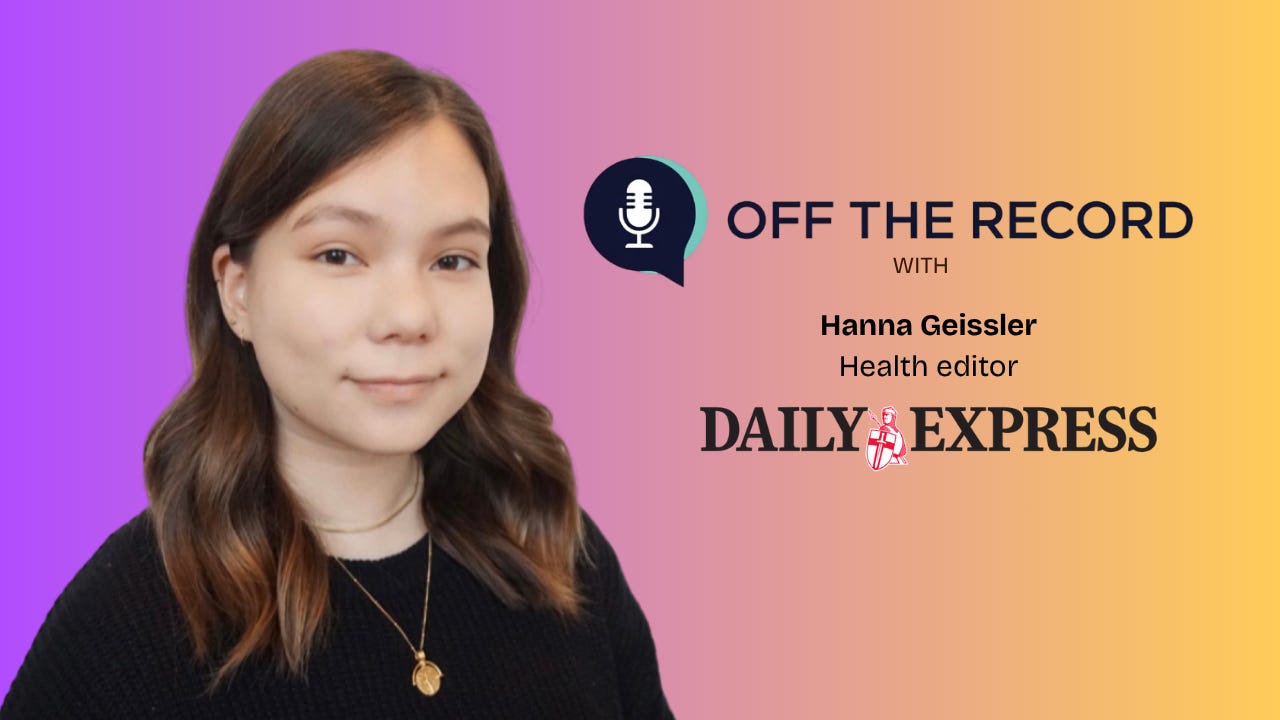
Hanna, you’ve told me that a lot of survey-based health stories you receive are problematic. What are the most common issues you see with survey data that comms pros should be aware of? Surveys should include at least 2,000 respondents, although there are exceptions such as if you’re polling a subgroup of people where it’s harder to get a large sample. Always provide your methodology. Who conducted the survey? How? When? Are your findings nationally representative? If a menopause clinic surveys women about their experiences by posting a link on social media, that survey will be biased towards people who are interested in its content — and probably more likely to have experienced difficult symptoms. Be clear about exactly who is responding.
In contrast, you’ve said case studies are often key to making a health story work. How do you like case studies to be presented? Full name, age, location, occupation, are they married/children/grandchildren? And, crucially, high quality photos. If they’re talking about a health diagnosis, then when was it? What were the first symptoms? How does it affect their daily life? If you can provide this key info upfront it makes me more likely to pitch the story than if I have to ask/am not sure you’ll share it in time. I’ve had a few issues recently with case studies only wanting to give a first name. That’s obviously understandable but usually means we can’t use them.
How can PRs balance storytelling with privacy or sensitivity issues when writing about health? Speaking publicly about a health condition can be an emotional and daunting experience. I always try to remember when working with case studies that what might be a quick interview that takes 20 minutes to write up could be a really significant moment in that person’s life. If they’re a member of the public, they’re probably not media trained and may need a little more reassurance and support. If someone is nervous and it’s a very sensitive topic, I’ll occasionally agree to a read-back but never copy approval.
There’s a risk that PRs pitch stories that oversimplify complex health topics. What advice would you give to comms people who want to make their message accessible without losing scientific accuracy? If I’m interviewing an expert and want them to describe something simply or use less technical language, I often ask them how they would explain it to a 12-year-old child. I’ll also sometimes paraphrase what they’ve just said and repeat it back to them to check whether I’ve understood correctly. Even the most complex scientific processes can be accurately simplified to provide the right level of detail for your reader. If in doubt, check with an expert.
If you could redesign the way comms pros approach health storytelling, what would you change? Is there anything you wish they’d do more often? Medical companies can be too focused on their side of the story and pitch as though they’re writing for a trade publication. You always need to bring the focus back to the patient. Data and trial results are great but can you make me feel something — hope, shock, excitement? I also love getting out and about. Recently I’ve observed a robotic surgery, visited a blood processing plant, and joined a brain MRI study. These visits also produced viral social media videos, something I’ve just started experimenting with (I’m on TikTok and Instagram). Stories come to life when you let journalists see things first-hand.
Quick fire time...
Best time to pitch you? Before 9am if it’s for tomorrow’s paper
Worst time to pitch you? Late afternoon
How many follow ups do you like to receive to a pitch? One if you genuinely think I would be interested and might have missed the email. Otherwise, none.
A memorable story you’ve recently written? The Express Christmas appeal, which launched at the weekend!
Best way to contact you? hanna.geissler@express.co.uk
Remember folks, keep this just between us! We’re off the record.
Thank you for reading Off the Record! There are more than 2,900 subscribers now! I want to make my weekly newsletter as helpful as I can, so please get in contact if there’s anything specific you want to see.
I also offer media masterclasses for brands/PRs/organisations looking to sharpen their storytelling, improve their relationships with journalists and boost their media coverage. If you’re interested, please email me at stephspyro1@gmail.com
You can also follow my journalism on Instagram, Twitter/X and BlueSky.