

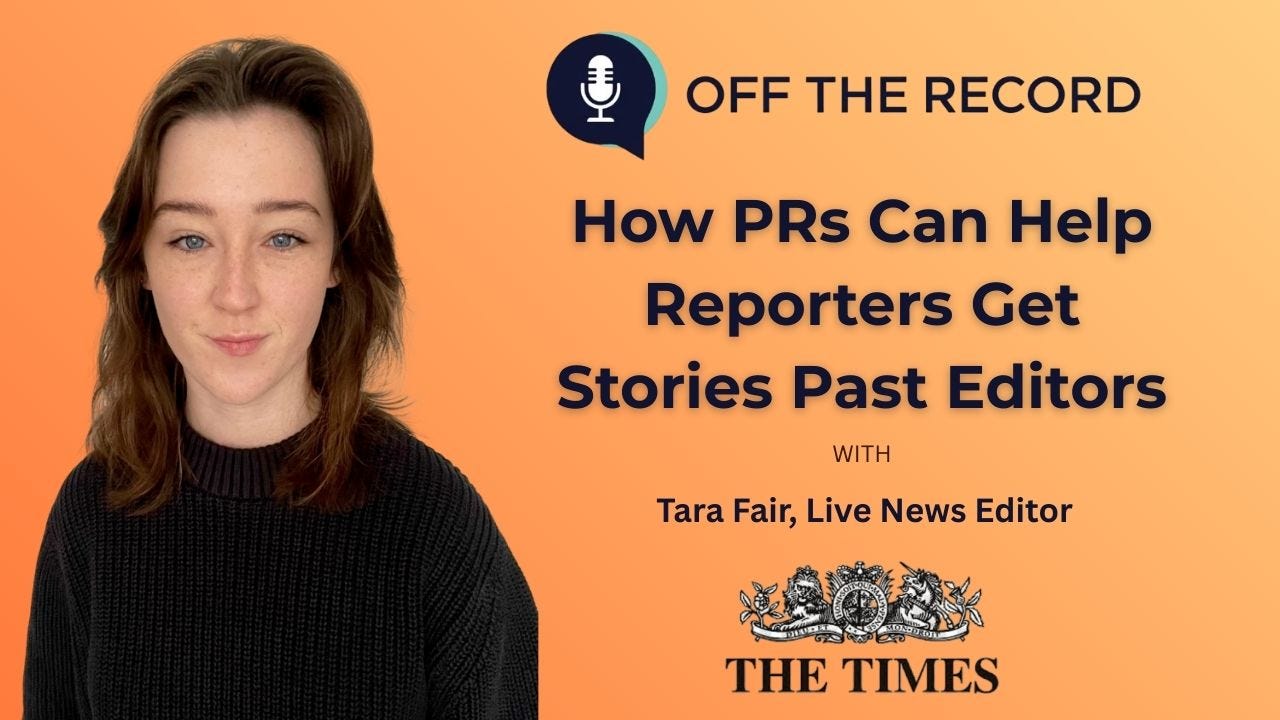
I’m thrilled to introduce you all to Tara Fair, Live News Editor at The Times. I’m extra excited about this edition because it’s the first editor featured on Off the Record.
Sometimes people ask “What can PRs do to help journalists get stories past their editor?” or “What’s the fastest way a good story idea can die in an editorial meeting or conference?” Tara answers these questions - and more (including about embargoes) in this week’s edition. So, over to Tara:
Can you spell out what a day in your life looks like as a live news editor? The main job of a live news editor is to make sure the homepage reflects the news agenda at any given moment, while being ready to respond quickly to breaking or moving stories. Live news editing runs from early morning through to late at night, with someone always overseeing coverage as events develop. A significant part of the role is managing live blogs, which are often the highest-performing stories on the site. These can be breaking news, but they’re just as likely to be planned well in advance around major events such as Davos, parliamentary votes or long-running trials.
Do you want to receive pitches directly? If so, what would help a pitch stand out? Yes, but selectively. There are broadly two types of pitches that make sense for editors: those tied to live blogs or major news moments, and those aimed at bigger, more in-depth projects. If you have an expert available to offer analysis about live developments at Davos, for example, that’s helpful and flagging it in the morning means we can circle back in a moment of calm. Editors are also often planning wider projects or campaigns in the background, so early notice of upcoming reports or sector-specific work can be helpful. Most mid-range stories don’t need to go to editors and are better directed to specialist reporters. But if a specialist reporter is away and hasn’t flagged an alternative contact, it’s fine to email an editor (only once) with a time sensitive pitch.
What can PRs do to help journalists get stories past their editor? Exclusivity still goes a long way and is often the first thing an editor will ask about. Strong visuals also matter — good pictures can make a real difference. Making a story human is vital and case studies are particularly valuable when people are willing to be named and photographed. If we can’t name and picture them we usually won’t use it at all. If you can’t provide a case then giving the reporter enough time to find one themself is vital. Above all, we’re pushing for quality over quantity. If a PR can clearly explain why a story is right for us and include links to similar coverage we’ve done before, it makes it much easier to argue the case internally.
What’s the fastest way a good story idea can die in an editorial meeting or conference? The quickest way to kill a story is finding out it’s already appeared in a rival publication. If we can’t add value to what’s already been produced we won’t do it at all and if we weren’t told it was being picked up by others it can sour relationships. Ideas also tend to fall flat when they’re backed by old data, or when it becomes clear they can only be illustrated with generic stock imagery.
How do embargoes help or hurt a story from your perspective? Arbitrary embargoes usually hurt more than they help. We’ve seen every variation imaginable, from 1.30am lifts to complex rules about what can run online versus in print. On a hybrid news desk working across both platforms, how frustrating an embargo feels often depends on which shift you’re on. But from a live news editor’s perspective, 6am or 7am embargoes can work well because they’re fresh on the homepage and catch the commuter spike — but only if the copy arrives well in advance so it can be properly built in the system and published on time.
To contact Tara, please email her tara.fair@thetimes.co.uk
Remember folks, keep this just between us! We're off the record.
Thank you for reading Off the Record! We want to make our newsletter as helpful as we can, so please get in contact if there’s anything specific you want to see.
We offer media masterclasses for brands/PRs/organisations looking to sharpen their storytelling, improve their relationships with journalists and boost their media coverage. If you’re interested, please email us at info@offtherecordmedia.co.uk