

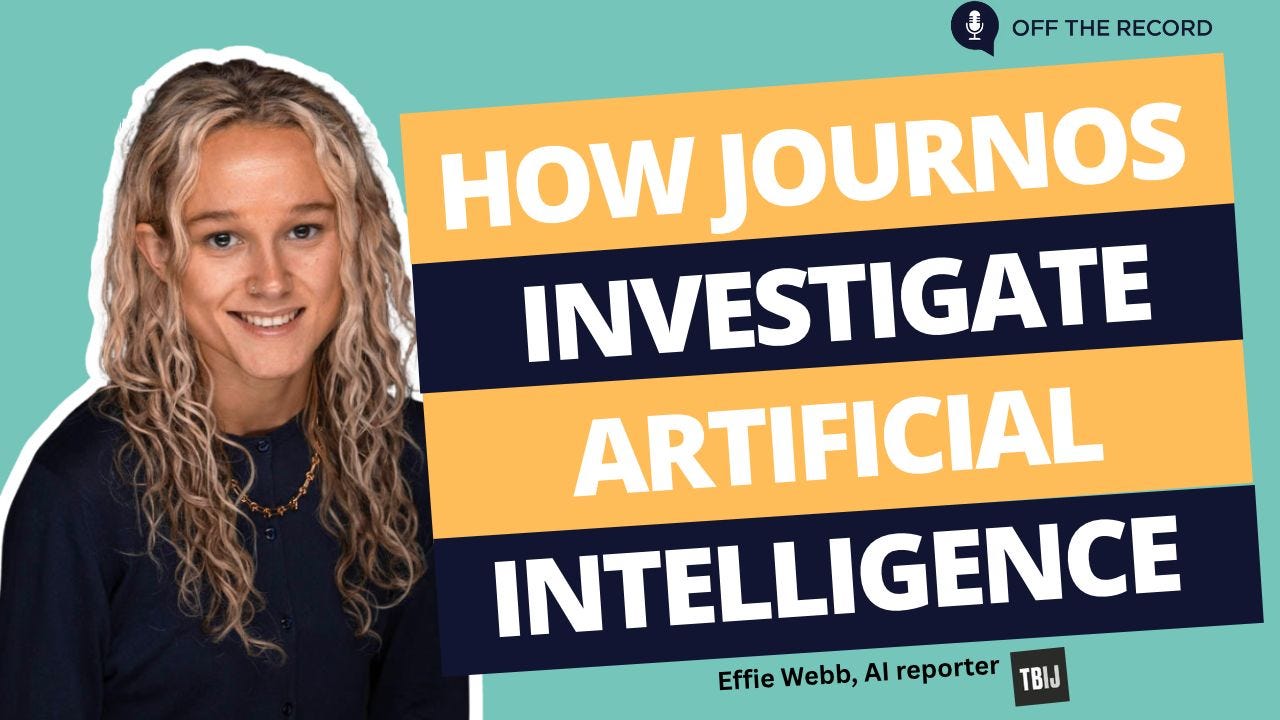
Artificial intelligence is everywhere but what makes an AI story worth a journalist’s time?
Effie Webb, from The Bureau of Investigative Journalism, takes the reins of Off the Record to share what she looks for when investigating Big Tech, the questions comms teams should be asking themselves and the responses that don’t help when a journalist comes knocking.
What makes you look at an AI story or pitch and think: “Yes, I want to investigate this”? Usually there needs to be a person, or a group of people, somewhere in the story who are feeling the consequences of the technology in a very real way. AI accountability reporting can become abstract very quickly, especially when the conversation is dominated by models, benchmarks and sweeping claims about the future, so I am much more interested in who is benefiting now, who is paying the price and who has the power to make those decisions.
A lot of the strongest investigations seem to fall into one of two categories. There is AI going wrong, where somebody uses a system to scam, deceive or harm people, and then there is AI working much as intended, where people use a product in ways its creators have actively encouraged and the consequences turn out to be rather less benign than the marketing suggested. I often find the second category more revealing because it tells you something about the incentives built into the product rather than simply pointing to a rogue user.
Your Character.AI investigation contributed to the company announcing major safety changes. What did that experience teach you about the relationship between investigative journalism and corporate accountability? It was a fairly rare example of being able to see a connection between sustained scrutiny and a company making substantial changes to how its product worked. Character.AI even cited media reporting when announcing some of those changes, which is unusual and made the relationship between scrutiny and response unusually visible.
There were other pressures involved, including lawsuits and families who had been raising concerns for some time, so I would be cautious about drawing a neat line from one investigation to one corporate decision. Even so, it was encouraging to see that reporting could form part of the pressure that forced a very large technology company to respond in a meaningful way.
The less comforting lesson is that many of the concerns were hardly invisible beforehand and families had already been speaking out for a long time. That raises a more difficult question about why it took lawsuits, sustained reporting and public pressure before some of those safeguards arrived. Accountability journalism can help force change, but sometimes the more revealing story is why the change required that much pressure in the first place.

If a company is using AI in its products or services, what questions should its comms team be asking internally before a journalist comes knocking? I would begin with an almost embarrassingly basic question, which is what the AI is actually for. If there is a genuine use case, the company should be able to explain what problem it solves, provide some evidence that it actually works and say clearly who benefits from it. From there, I would want to know who could be disadvantaged, what foreseeable misuse looks like, what happens when the system gets something wrong and whether those risks were considered before the product was launched.
Then there are the less glamorous questions that become extremely important once something goes wrong. What data is being used, where did it come from, who has access to it, is there meaningful human oversight and can somebody challenge a decision made by the system? I would also ask whether the company would feel comfortable explaining all of this publicly, because if the answer is no then that is probably worth examining internally before a journalist asks the same question.
Cost is going to matter much more too, particularly where public money is involved. If an organisation has spent millions introducing an AI system, it should be able to explain why the technology was needed in the first place and whether there is evidence that it represents value for money. I realise this starts to sound slightly like a compliance checklist, but these are exactly the sorts of questions reporters begin asking once the shiny launch announcement is over.
When a journalist approaches a company with difficult questions about its use of AI, what is the worst possible way for the comms team to respond, and conversely, what information do you wish companies would volunteer? Not replying at all is obviously fairly high on the list, but one of the more frustrating versions is a long phone call on background where a company gives genuinely useful explanations and then follows it with a written statement so generic that almost none of that context can actually make it into the story. You can end up in the peculiar position of understanding the company’s argument reasonably well while having very little usable material with which to represent it fairly.
I also become slightly suspicious when the first response is to ask which competitors I am approaching or whether everybody else will be getting the same questions, because usually I am asking about a specific decision made by a specific company. What another business may have done does not really explain that decision.
The most useful responses are often surprisingly straightforward. Answer the questions, point me towards relevant policies or documents, explain how the decision was reached and tell me if there is important context I have missed. If you think the premise of the story is wrong, say why and show me the evidence, because a substantive disagreement is far more useful than three paragraphs about how seriously the company takes safety.
You’ve investigated the people and systems behind AI, as well as the companies developing and monetising it. What do you think comms professionals most misunderstand about the AI industry? I cannot really speak for comms professionals as a whole, although I think everyone working around this industry has to be conscious of how extraordinarily good the AI sector has become at describing itself. There is an enormous, expensive and very polished messaging machine behind the industry and we are regularly told that large language models are going to transform medicine, education, science, work and almost every other part of human existence.
Sometimes there is good evidence behind those claims and sometimes there is a demo, a prediction and a very enthusiastic chief executive. The danger is that the industry’s preferred language starts becoming everybody else’s language too, so claims about capability, safety or productivity get repeated often enough that they begin to acquire the status of facts before the underlying evidence has really been tested.
Journalists fall into this trap as well and I certainly have. The useful corrective is usually to return to fairly basic questions about what the system actually does, how often it works, what it is being compared with, who produced the evidence, who makes money if we believe the claim and what happens to the people on the other side of it. AI is an unusually hype-heavy industry, so treating that hype as something to investigate rather than simply relay is increasingly important.
What AI story should comms professionals be paying more attention to over the next year? The changing public mood around AI. For the last few years there has been an assumption that putting AI into a product automatically makes it sound newer, cleverer and more desirable, but I think that period is fading as people become less impressed by the label itself and more interested in whether the technology actually improves anything.
People are starting to ask much more basic questions about whether these systems work, why they have been introduced, whether they are collecting more data, whether somebody is losing their job because of them, why they cost so much and whether users can simply turn them off. That shift matters because “AI-powered” is starting to look less like a universal selling point and more like something companies may actually have to justify.
I would also watch the growing world of GEO and AEO, and more broadly the question of what happens when information about companies is mediated through chatbots. If somebody asks ChatGPT, Gemini or another assistant about your organisation, what does it say, where did that information come from and is it accurate? For years communications teams have thought about what appears on the first page of Google, but increasingly the person asking the question may never see a page of search results at all. That creates a strange new reputation problem because the company is no longer dealing simply with what has been published about it, but also with what an AI system has decided to synthesise from everything else.
Quick fire time…
How do you use AI in your job? Mostly to help deal with enormous quantities of information. NotebookLM is a firm favourite and Google Pinpoint is brilliant when you have mountains of court documents or records that would otherwise take days to search manually. I find these tools most useful for helping me locate the interesting needle in the haystack rather than for doing the reporting or making the judgement that comes afterwards.
AI buzzword you never want to hear again? Anything implying inevitability, whether that is “the horse has bolted”, “the second industrial revolution” or the claim that AI is simply going to revolutionise everything. I always want to know what exactly is being revolutionised and on the basis of what evidence, because declaring something inevitable can become a very effective way of avoiding the more difficult argument about whether it is desirable, useful or even true.
What does “off the record” mean to you? It means you are giving me information that can help inform or advance my reporting, but I cannot publish it as information you gave me or identify you as the source. If I subsequently establish the same information independently, I can report what I have established without revealing where the original lead came from.
More importantly, those terms need to be agreed before the conversation starts because different journalists and newsrooms can use “off the record”, “background” and “not for attribution” differently. I would much rather establish exactly what we both mean at the beginning than discover afterwards that we had two completely different interpretations.
One piece of advice for a PR trying to build a relationship with you? If I have approached you for a comment, pick up the phone. A short conversation can often resolve something that would otherwise become ten emails and several misunderstandings, and it also means I end up with an actual person in my contacts who I know I can speak to rather than another communications address sitting in my inbox.
I would also make sure pitches are genuinely relevant. Flattery is lovely when it is sincere, but telling me you adored an investigation before making an extremely tenuous connection between it and whatever product you are selling tends to suggest you did not adore it quite enough to read it.
How to contact Effie? LinkedIn or email at effiewebb@tbij.com
Remember folks, keep this just between us! We’re off the record.
Thank you for reading Off the Record! We want to make our newsletter as helpful as we can, so please get in contact if there’s anything specific you want to see.
We offer media masterclasses for brands/PRs/organisations looking to sharpen their storytelling, improve their relationships with journalists and boost their media coverage. If you’re interested, please email us at info@offtherecordmedia.co.uk