

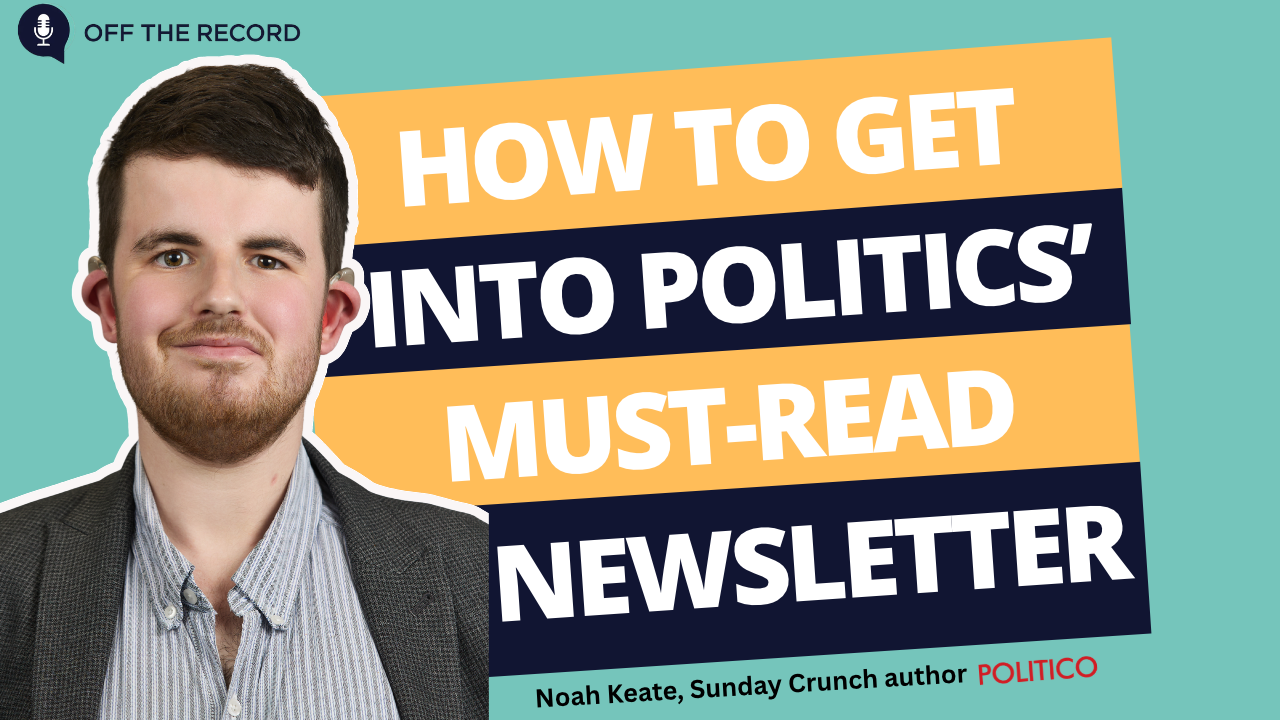
Sit back, relax and enjoy this edition… which is pretty much a newsletter about a newsletter!
Politico’s London Playbook and Sunday Crunch are mandatory eading in Westminster. They’re the guide to what’s happening, who’s talking to who and what everyone in the SW1 postcode needs to know. They’re read by political journalists, special advisers, ministers and the wider political world alike.
But what agoes on behind the scenes to produce it? How does it land in our inboxes fully formed, twice a day, every weekday? And how can comms pros get in on the action?
I’m thrilled to have Noah Keate, Politico’s Sunday Crunch author, in the hot seat for this edition. He’s pulling back the curtain on how it all comes together, what makes a story Playbook-worthy and what comms pros need to know if they want to get on his radar.
A quick plug before we get into this week’s edition… discounted tickets are now available for our second Off the Record live event.
On 15 October in London, we’ll be bringing together senior political journalists and Westminster insiders to talk pitching, building relationships, the Budget and how “the lobby” works… followed by drinks, nibbles and networking.
Grab your discounted ticket here. Right, back to business!
Noah, for someone who has never read London Playbook, how would you describe what it is trying to do every morning? London Playbook is a twice daily newsletter published at 7am and 5pm every weekday. The morning edition, which launched in September 2017, tells readers what’s happening in Westminster that day. The opening subheading “Driving the Day” is the clue — it’s a product designed to inform very busy people first thing in the morning about the forthcoming hours in SW1.
Key to the newsletter’s success is its usefulness — from highlighting striking scoops in the papers, last night’s events in the House of Commons or conveying information about what the party leaders and key spokespeople are up to, a reader should finish the newsletter informed about what those at the heart of power are talking about. Of course, the newsletter shapes, as well as reflects, that conversation.
The main readership is proudly and unapologetically the Westminster bubble: Cabinet ministers, special advisers, MPs, parliamentary staffers, political journalists and civil servants. As such, the stories included are designed first and foremost with them in mind. What do they need to know? Does this actually move things on? I began reading Playbook at university while studying politics — while my nerdery enthusiasm would have been appreciated, I was on the outer layer of the newsletter’s target audience.
Playbook — alongside the whole of POLITICO — is studiously impartial but that doesn’t stop us having lots of fun along the way. Nobody wants dull emails, especially at 7am, so the copy has a tremendous sense of irreverence and cheekiness with a plethora of puns to lighten people up. We never want readers to scroll past anything, meaning a playful approach alongside the hard-hitting news is essential.
Playbook PM is a very similar offering, except it explores what’s actually happened since 7am to move the political agenda. Often, there are well timed parliamentary statements, speeches or interviews that land just before 5pm, which provide a fresh offering for readers who may not have checked the news since the morning. If there’s a big event happening later in the evening, such as Andy Burnham meeting Donald Trump, the newsletter can also throw forward to this.
Sunday Crunch, which I’ve written since June, is released on Sunday afternoons and rounds up the best of the weekend political shows and stories. Sunday has been a political day that sets the Westminster weather for decades, so this provides a helpful guide for those tuning back into SW1 after steering clear of the news. It also means Monday morning’s Playbook can focus on the week ahead and doesn’t need to look back at the weekend too much.
If you could give comms pros three rules for dealing with London Playbook/Sunday Crunch, what would they be? Reach out to the author writing the next day’s newsletter. My colleagues Andrew McDonald (Monday to Wednesday) and Sam Francis (Thursday and Friday) split morning Playbook responsibilities while Emilio Casalicchio writes Playbook PM. They each spend lots of time reading press releases and speaking to ministers/advisers meaning a bid sent solely to the Playbook inbox might get lost in the deluge of news. Morning Playbook in particular involves strange working hours (more on that below), so expect calls/messages at unusual times to clarify information.
Make sure you’ve read some past editions to get a sense of what topics are likely to make the cut. In a packed newsletter, the information needs to be relevant to the audience mentioned above, telling them something interesting, engaging and, where possible, revelatory. The newsletters are forward facing, so timely bids that throw ahead to what’s going to happen are likely to land well.
Don’t be disappointed if your submission fails to make the cut. There’s a high demand to get featured and space is always tight, especially when there’s a lot of news going on. The team is very appreciative of pitches and, as the newsletters run so regularly, there’s always next time. We’d rather have too much to pick from than too little. For more information, I imagine newsletter authors would be happy to get coffees on what content works best.
How early does the Playbook team start working on the newsletter? Can you tell us a bit about that process? Morning Playbook appears to arrive effortlessly into your inbox every morning — but a bumper amount of work has gone into it behind the scenes. I spent my first year at POLITICO as the morning Playbook reporter, which involved writing the lower half of the email. I’d work from mid-afternoon putting blurbs together, attending events, speaking to press officers and following late breaking news.
For the main morning Playbook author, the work is on a different scale. The first editions of the newspapers don’t tend to drop until 9pm at the earliest, meaning an overnight shift poring over the political stories is the only option. A newsletter filed at 6pm the previous day is almost certain to be out of date by 7am.
Playbook PM’s hours, as you might expect, are slightly more normal — though a frantic writing time emerges at around 3pm right up until the newsletter’s publication at 5pm. The newsletter could be upended at the last minute by breaking news at 4.45pm, or a press conference kicking off at 5.15pm, which could make the copy redundant if the newsletter is sent early. There really are no hard and fast rules.
Sunday Crunch has an early start to trawl through the Sunday papers before the weekend political shows start. Cabinet ministers and opposition spokespeople are likely to get asked about topics/scoops which appear in the press, so being across what’s likely to get discussed is invaluable. It’s then a game of listening to the shows and picking out the freshest newslines ready for those who chose to have a Sunday off watching the weekend programmes.
All the newsletters involve not only writing but speaking to lots of people — special advisers, press offices, ministers, civil servants — for clarification about the day ahead and to ensure the newsletter is at the heart of the Westminster echo system … even as the morning Playbook authors are asleep when SW1’s day is beginning.
If I’m a comms pro and I think I have a story for Playbook, how should I pitch it?It’s best to contact the newsletter author directly via email or WhatsApp with a specific message about why the story is relevant to Playbook’s audience. A generic mass email is both easier to miss and harder to identify the key point. Our audience are clued up and in the know, so there’s a high bar for inclusion in a product read by key figures in SW1.
Given the earlier comments about the product driving the day, any details about how, where and why something is being done helps immensely. Playbook also values fun, colour and mischief — where appropriate, sprinkling that might also prompt a better chance of getting in if it’ll deliver a wry smile on readers’ faces.
The newsletters rely heavily on linking out to stories/reports, so that readers interested in the specific item previewed can pursue it in more detail. Therefore, flagging the key statistic/recommendation/finding very clearly is super useful, especially with an explanation about how it might move the dial in Westminster and is distinct from reports/campaigns that have been covered before.
What do you want a reader to feel they know after reading Playbook/Sunday Crunch that they wouldn’t necessarily know from reading the morning papers?The newsletters provide an engaging, insightful and thought-provoking narrative that links the key stories from the papers together — and saves readers time by leaving out the non-political stories that, while possibly important, aren’t relevant to their day. Rather than just a discrete reading of each paper, the newsletters offer a wider message/angle about what they’re conveying — and how that will affect subsequent behaviour in Westminster.
Playbook and Crunch also flag scoops and long reads of our own, as well as great political stories on online websites/Substacks that might not necessarily get an outing in the press. Again, while many of the papers reflect on yesterday’s events, Playbook is forward facing — all while feeding in the previous evening’s events where relevant.
Playbooks also have their own bread and butter basics which serves the Westminster crowd just right. Morning Playbook links to all the newspaper front pages, the political media rounds and a ‘London Calling’ section containing the Westminster weather, people’s birthdays (it’s often how some people remember to wish someone a birthday greeting!), notable job moves, political podcast recommendations and the infamous ‘Spotteds’ of people at receptions last night — made all the more better with an amusing speech or unexpected encounter.
Afternoon Playbook also includes many interesting political social media posts, highlights upcoming evening dos taking place and has some similar features to ‘London Calling.’ It helps the readers to all feel part of the Westminster village — and is integral to the newsletter because of who our audience is.
What’s something comms pros often think is important that actually doesn’t matter very much to you? The broad nature of British politics means some bids flagging reports, events or surveys can have a rather tenuous link to SW1 and don’t, on the surface, appear relevant to Playbook’s audience. While many of these pitches are worthy and fascinating, they don’t always meet the bar.
A report, for example, featuring the words/endorsement of a minister or senior political figure and a contemporary Westminster political hook is likely to do far better than a generic sounding survey which could feature in any newspaper.
Quick fire…
Finish this sentence: If you want to get into Sunday Crunch/Playbook, never… send pitches too late. Timing is always tight and the publication deadlines come far quicker and earlier than they first appear. Newsletter writers are busy people meaning as much notice as possible gives writers the best chance to come back with queries.
Email or WhatsApp? Both have their uses and are always jam packed with messages. WhatsApp is easier for quick one to one chats while email works better for lengthier press releases and links to, say, where a document or article will appear.
One thing that instantly makes you suspicious of a pitch? Good journalists should, to some extent, regard all pitches with a degree of suspicion. Any that appear overly generic but made to look personal are likely to raise a newsletter author’s eyebrow. There’s been a lot of coverage about this recently, but polling for an organization which confirms what the organization already stands for may also struggle to pass the sniff test.
You’ve ramped up your multimedia journalism recently. Tell me about that… Over the last few months, I’ve started posting videos on X, LinkedIn, Bluesky and Threads (remember that platform?) highlighting my work, including articles and Sunday Crunch. It’s a great exercise for concisely summarizing the top line of the newsletter and encouraging people to read the product. Even though I am a journalist who writes first and foremost, the opportunity to engage in more multimedia storytelling is very rewarding and fulfilling.
What’s your favourite part about being Sunday Crunch Author? The opportunity to analyze the political week that’s been and the one to come, by reading and watching quality political journalism and then imparting that insight to readers. Writing Crunch helps me feel more prepared for the week ahead, so I hope it provides the same service to readers.
To contact Noah, visit his Politico profile page . Read Sunday Crunch here. You can get hold of him on LinkedIn too.
Remember folks, keep this just between us! We’re off the record.
Thank you for reading Off the Record! We want to make our newsletter as helpful as we can, so please get in contact if there’s anything specific you want to see.
We offer media masterclasses for brands/PRs/organisations looking to sharpen their storytelling, improve their relationships with journalists and boost their media coverage. If you’re interested, please email us at info@offtherecordmedia.co.uk