

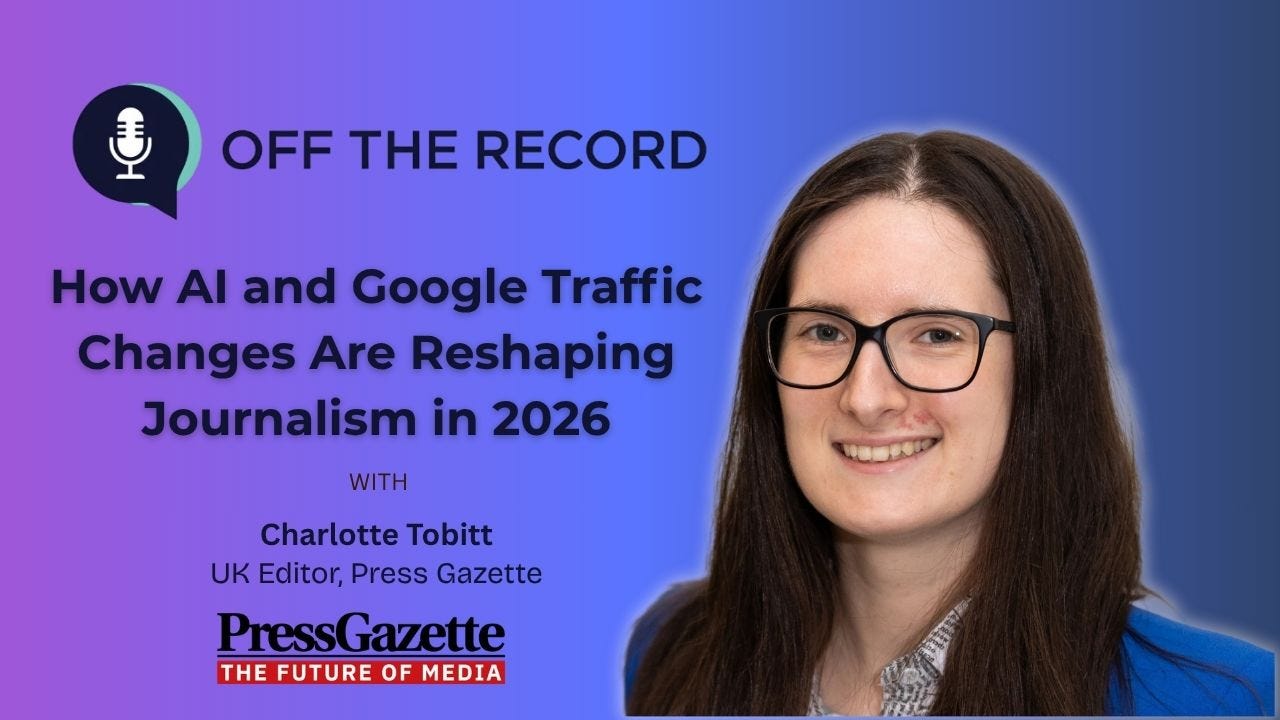
It gives me great pleasure to hand over this edition of Off the Record to Press Gazette’s UK editor Charlotte Tobitt.
She dives into the forces reshaping journalism right now... from the sharp decline in Google-driven traffic to the growing influence of AI across newsrooms.
As publishers rethink their strategies and double down on original reporting, Charlotte explores what these shifts mean for journalists, comms pros and the future of trusted news.
1. Charlotte, what has been the biggest shift you’ve noticed in terms of how journalism has changed in the last 18 months? The biggest change has been the fact that Google is no longer sending so much search traffic to publishers as a) it changes its algorithm to favour other types of content (eg sharing Youtube and X links in its Discover mobile feed) and b) AI Overviews now provide summaries in response to searches, meaning fewer people feel the need to click through to the original sources.
As a result many publishers have changed the type of content they are creating. For years many were creating SEO-driven and/or evergreen queries to get clicks and help support their core news journalism. But these are exactly the type of queries that are no longer getting as much traction in Google.
Instead, original reporting and analysis that can’t be found elsewhere is key - as is breaking news. These are the things that are harder for Google and LLMs to aggregate. I think this shift is only going to become more noticeable as 2026 continues.
2. Where do you think AI will have the biggest impact on the industry? My biggest concern is around the use of AI in content where it’s not known or disclosed.
To be clear, I don’t think this is a widespread problem right now. But there have certainly been examples that we need to learn from before it’s too late.
Last year a freelance journalist who appears not to be a real person managed to get several articles, which also included fabricated quotes, published in major newsbrands. It’s worrying that these got through to the publication stage before any red flags were used.
Just this week a senior media executive has been suspended after articles he wrote about the industry were found to have contained quotes from named individuals that were, in fact, AI hallucinations. He had used AI to summarise materials and not sufficiently checked the finished product. More widely, it is getting harder and harder to tell at first glance whether AI-created imagery is real or not. Supposed photos from Zendaya and Tom Holland’s wedding were the latest example.
The impact of all of this is that truth is getting more and more important. Journalists are uniquely placed to help people understand what is real and what’s not. So I think the news publishers that flourish will be the ones that take that seriously and don’t do anything to destroy that trust they have built up. To add a second part to this answer, the time savings from AI could make a huge difference to the amount of original journalism we are all able to put out into the world.
Aside from small changes like making it easier to file a story in the CMS with all the required bells and whistles, some publishers are now experimenting with AI agents helping them to write quotidian stories from press releases and other trusted sources. This means the trained journalists they employ can spend more time sniffing out stories that will ultimately add more to society.
With sufficient human checks this could be a net positive. But I do think we need to be cautious about any consumer-facing use of AI - and at least disclose it very clearly.
3. What advice would you give to comms pros looking to adapt to the changing media landscape? Don’t be tempted by shortcuts! Similar to the above, Press Gazette has done a lot of reporting over the past year on fake, AI-generated subject matter ‘experts’ making their way into major news publications. A lot of these have been pushed by bad PR actors.
So I think comms professionals need to be aware that humans are more important than ever at this point in time and they can help journalists decipher what’s real and what’s not if they do their job right. Make it easy for journalists to speak to case studies on the phone, for example. Don’t be offended if they want to do extra verification that they wouldn’t have done a year ago. In fact, why not offer all of these extra steps from the start?
4. What trend in the industry are you really excited about (which might potentially feel long overdue)? I’m thrilled by the fact that it’s now largely agreed that journalism has a value that is worth paying for. When I started at Press Gazette eight years ago the subscription-based publishers were the exception. Now, it’s basically the rule.
Even Reach, Daily Mail and The Sun all have premium paywalls on their websites now. Readers can still access the main news stories for free but they all have their own specialisms that mean they are producing content that no-one else is. If they build a relationship with their core audience, it’s a no-brainer that those people should pay for that.
The other key part of this trend is that the general public are now much more willing to pay. Platforms like Substack and Patreon have helped with this and that’s felt like a trend picking up tremendous momentum over the past couple of years. There’s still some distance to go bringing everyone along on this journey, but I find it really encouraging.
5. Is there anything about old-school journalism you wish could be brought back? There are some amazing court reporters working in the UK. But it’s much harder today for news organisations to gamble on a journalist spending hours at court for potentially no reward. Everything has to have a much surer return on investment. There’s no easy solution but I think more reporting from courts would be really valuable to our understanding of society right now.
Quick fire round:
Your favourite aspect of the media to write about? I love getting stuck into how decisions made by tech platforms in Silicon Valley affect large and small news publishers on this side of the Atlantic.
Something you wish comms pros better understood about your job? As much as we’d love to cover every small news update, we simply can’t. We need to concentrate on the areas that will provide most value to our readers. It’s similar at many news organisations now. But at Press Gazette that generally means what is and isn’t helping journalism pay in this digital age.
What has surprised you about being a journalist? Most people are willing to talk to you.
How can people get in touch with you? Feel free to drop me an email on charlotte.tobitt@pressgazette.co.uk or Linkedin is the best social network to find me on now (RIP Twitter).
Thank you for reading Off the Record! We want to make our newsletter as helpful as we can so please get in touch if there’s anything specific you want to see.
We offer media masterclasses for brands/PRs/organisations looking to sharpen their storytelling, improve their relationships with journalists and boost their media coverage. If you’re interested in finding out more, please email info@offtherecordmedia.co.uk